

river / run – Book Review
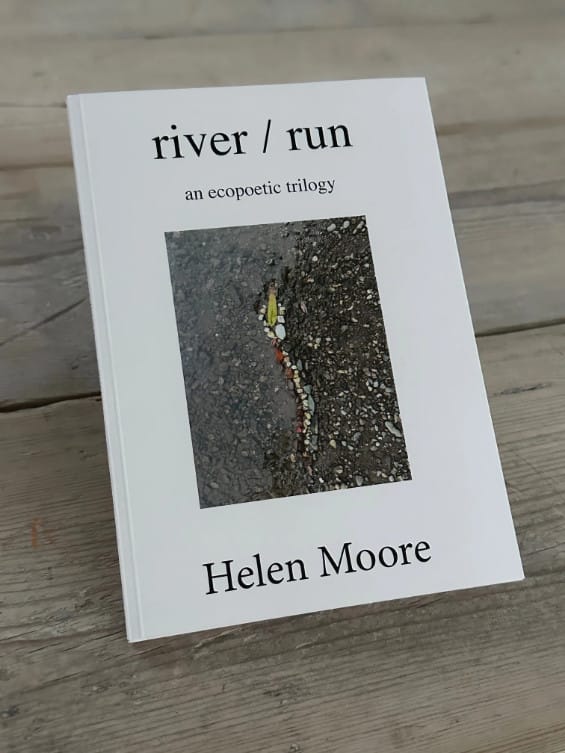
river/run an ecopoetic trilogy, by Helen Moore, October 2024. Cape Farewell, ISBN: 978-0-9553109-1-1, 61 pages. RRP £8.95 (paperback)
Helen Moore describes herself as a pioneering ecopoet and socially engaged artist. As she writes, “my work recognises our intrinsic interdependence with the more-than-human world, and the catastrophic harms that our collective anthropocentrism is causing.”
The book consists of three long poems: “Findhorn Bay: Waves of Flow and Flight”, “Dorset Waterbodies, a Common /weal”, and “Edge of Wild River”. The theme of this poetic trilogy is the migration of Wild Atlantic Salmon (Capitals as used by the author) back to the place of their birth in British rivers. It was at Findhorn Bay in 2018 that Moore first witnessed a salmon run and in the first poem she reflects on that experience, honing in on the wonder of salmon being able to navigate long distances back to the place of their birth:
from furthest Atlantic
without satellites or maps,
but following the soul’s call
instinct and geomagnetic sensing to return
here, through this gateway to the place of birth
Moore places the Salmon run in the context of the Earth’s evolutionary history, noting that this journey:
began long before humans even knew this Earth
A thousand thousand generations & more these homing fish –
Moore emphasises here that the Earth is not just for humans, and the wider than human creation has been around for considerably longer time. At the end of the poem she asks the poignant question: Can we inhabitants of this place learn to live within its rhythms to rise with greater wisdom?
Helen Moore’s website: www.helenmoorepoet.com includes a soundtrack of the author reading this poem and I found this a help in understanding it.
The second poem, “Dorset Waterbodies, a Common/weal” resulted from a writing project sponsored by Cape Farewell which has been publishing scientific, art and cultural collaborations for over twenty years, as non-profit making organisation. It deserves a higher profile, and details can be found at: www.capefarewell.com The poem lays bare some of the ways human activity has destabilised this delicate ecosystem, including a graphic description of the challenges that dairy farming poses to salmon as they struggle to breathe and navigate back up the river. Moore does not shy away from the issue of raw sewage and the idea of “water improvement” and she ends her vivid descriptions of river pollution with an accusation:
Your industrialised life is our death
By a thousand C U T S
The emphasis on the last word almost screams out of the page with pain.
Moore’s ecopoetic paradigm shift comes to the fore as she speaks out for the salmon and other river communities, referencing their place in evolutionary history:
So don’t speak to us of ‘improvement’.
We who’ve been here eons longer
than your short spell on Earth
are sovereign communities,
have the right to self-determine.
This ecocritical verse more than hints at the existence of rights of nature. Moore’s critique of the dominant discourse of “water purity” is even clearer in subsequent verses where she urges us not to blame the rivers for floods and ruin of crops and houses. She deftly describes how restoration of water habitats should happen, and the poem ends with a plaintive plea.
Come bring gentler hands to co-operate –
Let’s be communities of diverse voices
With a common future.
river/run,as eco-poetry, is very different from traditional nature poetry and should inspire us to be attentive to the voices of the wider than human creation, and its cry for habitat restoration along our rivers. The book also contains some excellent photographs, including a shocking depiction of lice infestation, transmitted from fish-farmed to wild salmon. The 2024 book launch is available on You Tube, where Moore gives an insightful presentation and reads several extracts. This is definitely a good way to tune into the challenge this book presents to us.
Stephen Retout
Comments on "river / run – Book Review"
No comments found.Add your own comment to "river / run – Book Review"
Next: Rooted in Hope – Book Review
Previous: Love, Anger & Betrayal – Book Review
Leave a Reply