

Sabbath Economics – Book Review
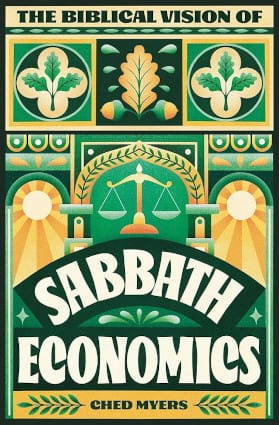
The Biblical Vision of Sabbath Economics, by Ched Myers, June 2023. Lab/ora Press, ISBN 978-1739716240, 130 pages. RRP £5.99 (paperback)
This book first came out in 2001, with a second edition in 2023. There is not much in the way of new material but given what has happened over the last 25 years, both nationally and internationally, the book remains strikingly relevant. The crises we face have only amplified his message, whether climate collapse, environmental degradation, the cost-of-living crisis, catastrophes caused by wars (in Gaza, Ukraine and Sudan to name but three), Covid, or the huge transfer of wealth to the super-rich. Things don’t look good right now, whichever way you look.
With Pope Francis declaring 2025 a Jubilee, this seems a good year to be looking (again) at the economy and the possibilities for continuing to generate alternatives to the present economic consensus. Sabbath Economics can help rekindle our imaginations and refocus our cry that another world is both possible and necessary. Ched Myers stakes his claim in the first few passages: that the world as created by God is abundant with enough for all; that disparities in wealth and power are not natural but are the result of human sin, and that the prophetic message calls people to the practice of redistribution. Even in 2001 he wrote about the increasing concentration of wealth in the richest 1% and with the consolidation of both power and wealth in the hands of fewer and fewer (not least the tech bros who did so well through the Covid pandemic), the need for that prophetic voice to articulate an alternative language and practice that can loosen the grip of market thinking is increasingly urgent.
Ched Myers roots the vision of Sabbath Economics firmly in the biblical tradition – a vision that he says continues to haunt our history. He brings alive the traditions of Sabbath practice from the texts of the Torah, the books of Exodus, Numbers and Deuteronomy, with their call for limits to consumption and for practices of redistribution, illuminating the two principles of Sabbath Economics: enough for everyone and a prohibition on accumulation. Moving to the New Testament, Myers says that Jesus was a Jubilee practitioner, starting out his public ministry with what is called the Nazareth Manifesto from Luke’s gospel (4:16-21). The book draws on encounters recorded in the gospels and illuminates their significance for us today. Ched Myers is both scholarly and skilful in the art of biblical exegesis. Whether it is his reading of the parable of the talents, the wilderness feeding or Paul’s writing to the people of Corinth, he gives us fuel for the journey, with built in examples of practical responses.
I think the book lends itself to group study and I hope to use it for just that, along with CAFOD’s Jubilee 2025 study guide, something from Local Futures (localfutures.org/) and perhaps the different voice of Gary Stevenson (find him on YouTube) on the necessity of tackling wealth disparities to promote human flourishing.
Jonathan Morris
Comments on "Sabbath Economics – Book Review"
No comments found.Add your own comment to "Sabbath Economics – Book Review"
Next: Love, Anger & Betrayal – Book Review
Previous: On Your Bike – Book Review
Leave a Reply