

Christian Environmentalism – Book Review
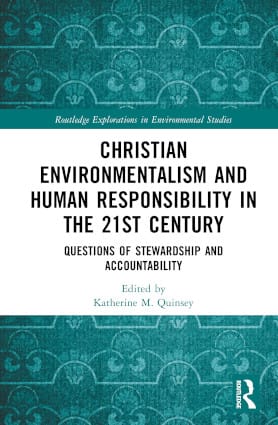
Christian Environmentalism and Human Responsibility in the 21st Century: Questions of Stewardship and Accountability, Katherine M. Quinsey (Editor), March 2025 (paperback). Routledge, ISBN 978-1032433134, 238 pages. RRP £38.99 (paperback)
This book is about everything contained in the title, but not necessarily in the ways you might expect. It is inspired by the life and work of Deborah Bowen, the retired chair of English at Redeemer University in Hamilton, Ontario. Her work focuses on poetry and the environment, and the pieces in the book include reflective and creative writing as well as ecocritical readings of literature which explore themes of creation, earth and non-human nature. Most of the contributors have connections with Redeemer University or with Hamilton, and many of the pieces are grounded in a strong sense of place, often place under threat, such as the floods in small town Iowa described in Samuel Martin’s ”Can You Make This All Run Again?” The Art and Environmentalism of Margo and Rein Vanderhill. The literature explored in the book covers a wide range, from Paradise Lost and 17th century sermons to Jesus of the Deep Forest by the Indigenous African poet Afua Kuma, from Thi Bui’s graphic memoir of her family’s experiences as Vietnamese refugees to Margaret Atwood’s MaddAdam trilogy. The subjects are not limited by narrow literary definitions, including the lyrics of Bruce Cockburn and a treaty, again from the 17th century, between Indigenous people and settlers.
The styles vary from ostensibly simple observation and humour (especially in the short story Bandits, about an accountant, his chickens and their raccoon adversaries) to challenging theological perspectives, with reference to the via negativa, sacramental theology and the work of Teilhard de Chardin, but there is a unity of tone throughout, and a sense, when browsing from one piece to another, that they are part of the same whole. This may partly be owing to the fact that the writers have close connections with one another, with institution and locality, but I think it stems from something more as well. There is no effort to underplay the scale of natural and climate catastrophes, but against their backdrop there is an intense and loving recognition of creatures, human and otherwise, landscapes and all that is being lost. This loss is true, the book seems to say, but so too is the wonder, the joy of beholding. John Terpstra’s Invasive Species concludes:
I stand here, a non-native son,
though born on this soil,
and walk my walk,
banging through the woods
cowbell around my neck
head in a cloud of bugs,
birds nesting in my beard,
searching for a place that will call me home.
The gentle ambiguity of those final words encapsulates the generosity, care and yearning that characterises this volume. It is not a book that needs to be read in linear fashion, but dipping into it at random produces delights of many kinds. Not least among them, in these dark days, is the reminder that faith in North America still has much to teach us about nature, community and human experience, and that neither responsibility nor compassion have been forgotten.
Tanya Jones
Comments on "Christian Environmentalism – Book Review"
No comments found.Add your own comment to "Christian Environmentalism – Book Review"
Next: On Your Bike – Book Review
Previous: Sacred Nature – Book Review
Leave a Reply