

Sacred Nature – Book Review
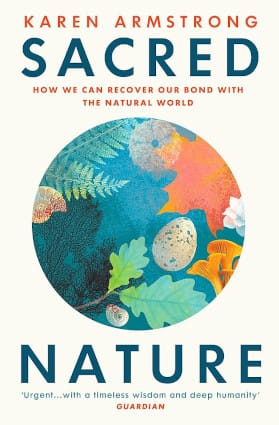
Sacred Nature: How we can recover our bond with the natural world, by Karen Armstrong, June 2023. Vintage, ISBN 978-1529114799, 256 pages. RRP £10.99 (paperback)
Karen Armstrong is a remarkable woman. At the age of 17 she became a nun. She later wrote about the harshness of the life she had entered with its old fashioned and brutal ascetic practices. Still, her community supported her in going to Oxford where she read English and it was while she was a student that she decided to leave the Order. She was awarded a congratulatory First and began a long exploratory odyssey. It has led her to examine in her many books the place of women in religion, the Bible, how the different world religions relate together and a wondering about the very nature of God. In 2008 she received the TED prize for a talk in which she launched a Charter for Compassion. Surely her words are of critical importance in our world today: “We urgently need to make compassion a clear, luminous and dynamic force in our polarized world. Rooted in a principled determination to transcend selfishness, compassion can break down political, dogmatic, ideological and religious boundaries. Born of our deep interdependence, compassion is essential to human relationships and to a fulfilled humanity. It is the path to enlightenment, and indispensable to the creation of a just economy and a peaceful global community.”
Her most recent book, Sacred Nature, follows through that vision of compassion into our response to the climate and nature crisis. Drawing on a deep and comprehensive understanding of world religions and their writings, Armstrong suggests ways we might value their spiritual practices for recovering our bond with the natural world. Delving into Confucianism, Daoism, Hinduism, Buddhism, kabbalistic Judaism, mystical Christianity and Islam she finds much with the power to restore our “primordial link with nature”. So many doors are opened for the reader that it is hard to summarise the scope of this book. But her aim is clear. It is not that we should change our own beliefs. A very helpful opening chapter distinguishes between logos as objective facts and mythos as what “helps us to glimpse new possibilities”. Armstrong encourages us to experience how ancient religious myths can open us to a deeper love of nature. “We need to recover the veneration of nature that human beings carefully cultivated for millennia; if we fail to do this our concern for the natural environment will remain superficial.”
The insights gathered are in each chapter grounded in a section headed The Way Forward. In one I found what spoke to me, and so it may be for each reader. For me it was in how the 17th century Jesuit missionaries brought their theology of a transcendent God into a culture where the ultimate reality was felt not to be a matter of verbal concepts. Yet after describing Dao as the “ineffable, unknowable source of being”, and in Hinduism Rta as “a sacred animating force”, we are reminded that in the early Christian tradition too we have Dionysius writing of God as ‘abiding within all things’. “If we develop a mind that ‘watches and receives’ (Wordsworth) and discover the fluidity of our natural environment, we may be able to recover some of our ancestors’ vision of a sacred nature”. That was the gem that sparkled for me; and there are many more in this book.
Andrew Norman
Green Christian Chaplain
Comments on "Sacred Nature – Book Review"
No comments found.Add your own comment to "Sacred Nature – Book Review"
Next: Christian Environmentalism – Book Review
Previous: Come, Have Breakfast – Book Review
Leave a Reply